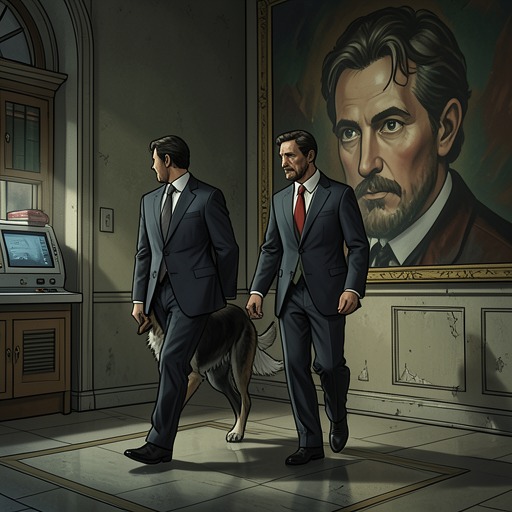
Sharikov’s atavistic state
The Heart of a DogSharikov’s atavistic state is the retreat of his humanized form toward canine life, a change that resolves the apparent disappearance of Poligraph Poligraphovich Sharikov while exposing the limits of the operation that made him. At the end, the living Sharik appears before investigators as an answer to a murder charge: the transformation has not produced a stable human being, and its result has reversed.
Meaning and Development
The state becomes publicly visible after a man arrives with a charge-sheet accusing Professor Preobrazhensky, Doctor Bormenthal, Zinaida Bunina, and Darya Ivanova of murdering Poligraph Poligraphovich Sharikov, identified in the charge as a sub-department controller of the City of Moscow Cleansing Department. The accusation turns the question of Sharikov’s identity into a legal problem: the investigators understand him as a man who has disappeared, while Professor Preobrazhensky answers that Sharik is alive and that nobody has killed him.
The professor’s answer depends on the distinction between speech and human identity. He asks the investigators to produce Sharik, then explains that the animal had spoken but had begun returning to a primitive state. He names the process atavism and says that science has not yet found a way to turn animals into people; his own attempt, he admits, has failed. The explanation does not deny the transformation’s reality. Instead, it recasts Sharikov’s human period as an unstable interval rather than a completed conversion.
The Return Before the Investigators
Doctor Bormenthal leaves the room and returns with a dog whose coat is unevenly grown: some patches remain bald while others have grown back. The dog first enters upright on its hind legs, then drops to all fours, looks around, and rises again before sitting in an armchair. These actions make the change legible as a return in progress, not a neat restoration already finished. The crimson scar on the dog’s forehead further identifies the body that stands before the investigators as the subject of the operation.
The reversal unsettles the official inquiry. One policeman crosses himself and knocks Zinaida Bunina’s legs from under her as he steps back; the man in black, who had read the accusation, is astonished. When he observes that Sharik talked, the professor says that he still talks, though less and less, and that this may be the last opportunity to hear him. The dog then barks and stands up in response to the discussion. Speech remains, but it is diminishing; the final bark makes the retreat audible at the very moment it is explained.
Names, Records, and Identity
The preceding effort to establish Sharikov’s human identity had relied on naming and paperwork. Asked what he will call himself, the man straightens his tie and gives the name Toligraph Poligraphovich; when asked about a surname, he insists on using his real name. Shvonder proposes a certificate identifying the bearer as Poligraph Poligraphovich Sharikov and even leaves the place of birth to be completed as the flat. The professor rejects this formulation, objecting that Sharikov was not born there.
That bureaucratic naming attempt gives the later charge its apparent certainty: it presents Poligraph Poligraphovich Sharikov as a registered official whose disappearance requires an investigation. Yet the scene of return unsettles the identity the document asserts. The investigators must confront the living dog as the same being they have classified as a missing human, while the professor treats the animal’s survival as decisive proof against the charge. The conflict is not simply over what name to write, but over whether a name and official status can make the transformation permanent.
Consequence and Significance
Sharikov’s reversion changes the outcome of the inquiry without erasing what happened. The man in black demands that the professor produce the missing Sharikov; the appearance of the dog supplies an answer, and the professor argues that the accused person is alive. At the same time, the dog’s remaining speech and altered coat show that the transition has not been presented as an instantaneous return to an untouched prior condition. The body carries visible evidence of the experiment even as its behavior moves back toward animal life.
The ending therefore turns an apparent murder mystery into a failed transformation made visible. Administrative identity, human speech, and the dog’s continuing life occupy the same room, but they no longer settle into a single stable category. The professor’s explanation closes the question of what happened to Sharikov while acknowledging the limits of scientific control: he tried to make an animal into a person, and the result began to revert.